
Live cam shows vs. recorded adult videos: key differences
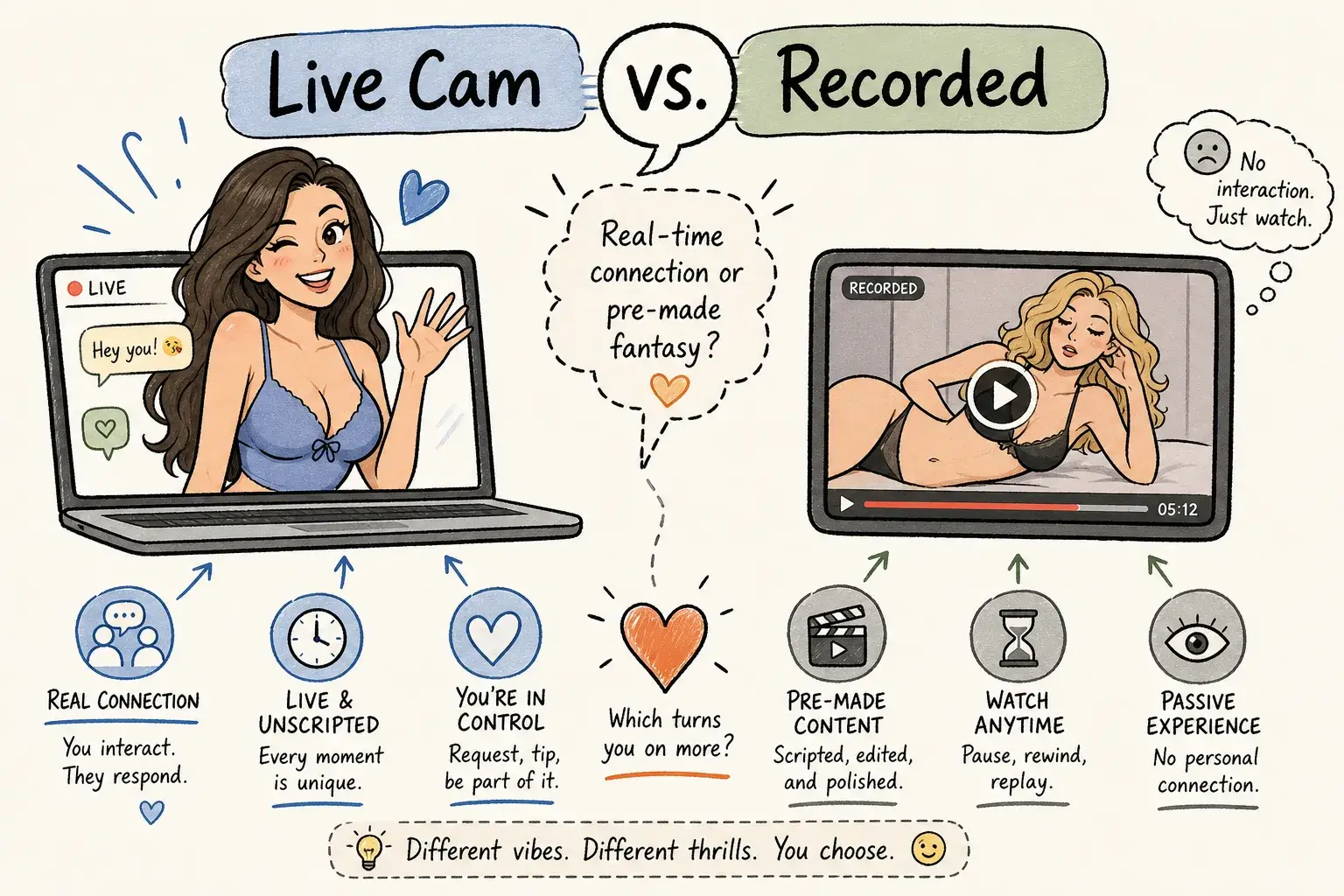
Most people treat adult content as a single category. You click, you watch, you move on. But live cam shows and pre-recorded adult videos are not the same product. They run on different technology, operate under different legal frameworks, and deliver a fundamentally different experience for anyone sitting on the other side of the screen. Treating them as interchangeable is how people end up with privacy problems they didn’t anticipate, or waste money on a “live” session that was shot three years ago.
This article covers the practical differences that actually matter: how each format works under the hood, what genuine real-time interaction looks like versus a scripted clip, how privacy and data exposure differ between the two, and what U.S. law says about recording, redistributing, and participating in sexually explicit content online. By the end, you’ll also know exactly how to spot a fake stream before it costs you anything.
How live cam streaming and pre-recorded video actually work
Live sex chat platforms are built around real-time, two-way audiovisual streaming. The performer’s camera and microphone capture content as it happens, and that data travels to the viewer almost immediately. Industry benchmarks for WebRTC-based infrastructure put typical latency in the 50-to-200-millisecond range when the underlying architecture is optimized for it. Pre-recorded adult video sites work in the opposite direction: a file was produced, edited, uploaded, and now lives on a content delivery network waiting for someone to press play. The infrastructure priorities are entirely different.
For live platforms, everything is optimized for low-latency connection management, real-time compression, and session handling. For recorded-video sites, the focus is storage, transcoding, cataloging, and smooth buffering so files play without interruption. A live cam session is ephemeral by design, it happens, it ends, and unless someone deliberately records it, the moment passes. A pre-recorded clip is identical every single time someone watches it, for as many viewers as want to queue it up simultaneously.
Content creation looks completely different on each side of this divide. Live performers create on the fly, responding to what’s happening in the moment. Recorded-content creators produce polished files in advance, often with editing, post-production, and professional lighting. The gap between raw and produced isn’t a quality judgment. It shapes everything else about the user experience.
What genuine real-time interaction actually delivers
The defining feature of a live cam show isn’t the video quality, it’s the responsiveness. The performer responds to you specifically, in that session, in real time. You can make a request, ask a question, or redirect the interaction entirely, and the person on the other side reacts to exactly what you said. No pre-recorded video, regardless of production value, can replicate that. A clip is a fixed performance shot for a general audience; it plays the same whether you’re watching or not. Think of the difference between requesting a specific song from a musician playing your table versus streaming their album, the content may overlap, but one exists entirely without you.
Viewers who want passive consumption or background entertainment can find that in recorded video. Viewers who want connection, acknowledgment, and a session shaped by what they actually communicate are looking for something only a live format can provide. Those are two distinct products serving two distinct needs.
SexChatShow.com is built around a live-only model. According to the platform, every stream is happening in real time, with no recycled clips, no looped previews dressed as broadcasts, and no pre-recorded content filed under a “live” label. The platform offers anonymous guest access across niche categories including MILF, BBW, gay, lesbian, trans, BDSM, and cam-to-cam rooms, without requiring account creation or a subscription fee. A 1-on-1 private room option is also available for sessions with a single performer.
Privacy and data: how the two formats handle your information differently
Live streaming and recorded video create different privacy risk profiles. Live sessions carry higher immediate exposure risk. Content is captured and transmitted as it happens, which means there’s no editing pass, no approval layer, and no chance to retract what’s already been seen. If a session is recorded by either party, that recording can potentially circulate long after the session ends.
Platforms that require account creation for live access compound this by collecting personal data tied to your viewing activity. Usernames, email addresses, payment information, and session history all become part of a data trail that persists on the platform’s servers. Recorded adult video sites operate differently but create a more durable privacy footprint. The content is the product, so these platforms store videos, metadata, viewing history, and user behavior for search, recommendations, and playback. The risk isn’t immediate exposure; it’s long-term retention and the possibility that data gets breached, sold, or subpoenaed years later.
No-registration access substantially limits the most common data concern. When a platform doesn’t require you to create an account, there’s no username, no email address, and no viewing history tied to your identity, though platforms may still collect session metadata and IP information regardless of registration status. This is a built-in privacy advantage, not just a convenience feature. Platforms designed for real-time anonymous access operate on a fundamentally different model than those built around user accounts and content libraries. Browsing in incognito mode limits local traces on your own device, but it doesn’t mask your activity from the platform itself. The cleaner solution is a platform that minimizes what it collects from you in the first place.
Legal realities worth knowing before you participate
Both formats sit within a complex legal framework, but they generate different types of exposure. For live webcam content, the most pressing legal concerns are age verification, recording consent, and federal recordkeeping requirements under 18 U.S.C. § 2257. That statute defines “producer” broadly enough that a live performer creating sexually explicit content on camera may carry compliance obligations. Because the interaction is real time, identity checks happen at sign-on rather than through an edited file, making age verification gaps a more acute risk on live platforms.
Recording a live sex chat session without consent is a line users frequently cross without realizing it. Under federal law, one-party consent is the baseline, though state law can and often does impose stricter requirements that supersede the federal floor. Ten U.S. states, including California, Illinois, Pennsylvania, Florida, and Washington, require all-party consent for recording private electronic communications. If you’re in one of those states and you screen-record a live session without the performer’s agreement, you may be violating state wiretapping or privacy law.
Recording consent and redistribution law are separate issues. Even in a one-party consent state, sharing an intimate recording without the subject’s permission can trigger nonconsensual intimate image statutes and federal civil liability under 15 U.S.C. § 6851, which provides for statutory damages up to $150,000 per violation.
For recorded adult video, the legal exposure shifts toward distribution-based offenses. Downloading, reposting, or redistributing pre-recorded content without proper authorization can create copyright liability, privacy claims, and obscenity exposure. Live cam performances can qualify as copyrightable creative works once captured in a recording, and copyright registration strengthens enforcement significantly. Federal obscenity law applies to both formats if the material meets the constitutional standard, and both are subject to federal jurisdiction when transmitted across state lines via the internet.
How to spot a fake “live” stream before you waste your time
Pre-recorded content sold as a live stream is one of the most common forms of deception on adult platforms, and the tells are usually visible once you know what to look for. The clearest sign is repeated exact movement: the same gesture, head turn, or body motion appearing again at regular intervals with identical timing and framing. Genuine live video produces continuous, unscripted variation. A looped clip reproduces the same action patterns with a precision that real-time behavior doesn’t replicate.
Watch for these additional red flags:
- Chat responses that are generic, delayed, or completely disconnected from what you actually typed
- A performer who never acknowledges messages, requests for pose changes, or specific questions
- Abrupt cuts, sudden lighting shifts, or background changes that suggest the broadcast is built from spliced segments
- Session “previews” that play identically every time you reload the page
- A “live” badge on content that shows no spontaneous behavior
Broader platform red flags follow a predictable pattern. Pressure to pay off-platform via gift cards or cryptocurrency, profiles reusing stolen images, vague or missing company contact information, and phishing messages disguised as account verification are all signals that a platform isn’t operating legitimately. Scammers specifically target the live format because real-time urgency is harder to verify than a static listing, and manufactured pressure prevents users from doing basic due diligence before they hand over payment details.
The practical verification habit is simple. Test whether the performer responds directly and specifically to something you type, ask for a wave, a visible acknowledgment, or a reaction to a particular request. A real-time stream answers in real time. A pre-recorded loop doesn’t know you’re there.
Concrete steps to protect yourself on adult platforms
Start with your device. Use a personal device not linked to work or school accounts, and avoid platforms that push you toward account creation when registration isn’t actually required for what you want to do. Never share real names, phone numbers, or payment information through channels outside the platform’s official system. If a platform is asking for sensitive data to access free content, that’s not a feature, it’s a data collection mechanism.
When evaluating a platform, run through a short vetting checklist:
- Does the platform require registration, or can you browse and interact anonymously?
- Is all content explicitly live, or does the site mix pre-recorded clips into the stream feed without disclosure?
- Are payment systems handled on-platform with transparent terms, or are you pushed toward external payment methods?
- Does the platform have a clear no-pre-recorded-content policy, and does the stream behavior actually support that claim?
SexChatShow.com is designed to meet that checklist: free access, no sign-up required, live-only streams, and a platform structure that doesn’t require you to hand over personal information before you can see what’s happening in the rooms. Any live adult platform worth using should clear those same bars, and if you want examples or a starting point, see our 10 Top Sex Chat Sites for Live Adult Entertainment.
For more on staying anonymous and controlling what information you reveal during private sessions, review our private adult chat tips.
The difference is real, and it matters
Live sex chat and recorded adult video are not two flavors of the same product. The technical gap between real-time streaming and on-demand video file hosting drives every downstream difference in user experience, privacy exposure, and legal risk. Sessions that respond to you in the moment cannot be replicated by a clip produced for a general audience, and the data footprint you leave on a no-registration live platform is meaningfully smaller than the persistent trail built by an account-based recorded-video service. Whether you care most about genuine interaction, privacy, or simply not getting scammed by a looped clip dressed as a broadcast, understanding how these two formats actually work is the most useful thing you can take from this comparison. For a deeper look at modern approaches to delivering live video streaming vs WebRTC, there are technical guides that explain how low-latency systems differ from traditional streaming stacks.